
Connected Britain returned to ExCeL London on 9–10 September 2026 for its biggest edition yet, bringing together more than 8,000 people from across the UK connectivity sector.
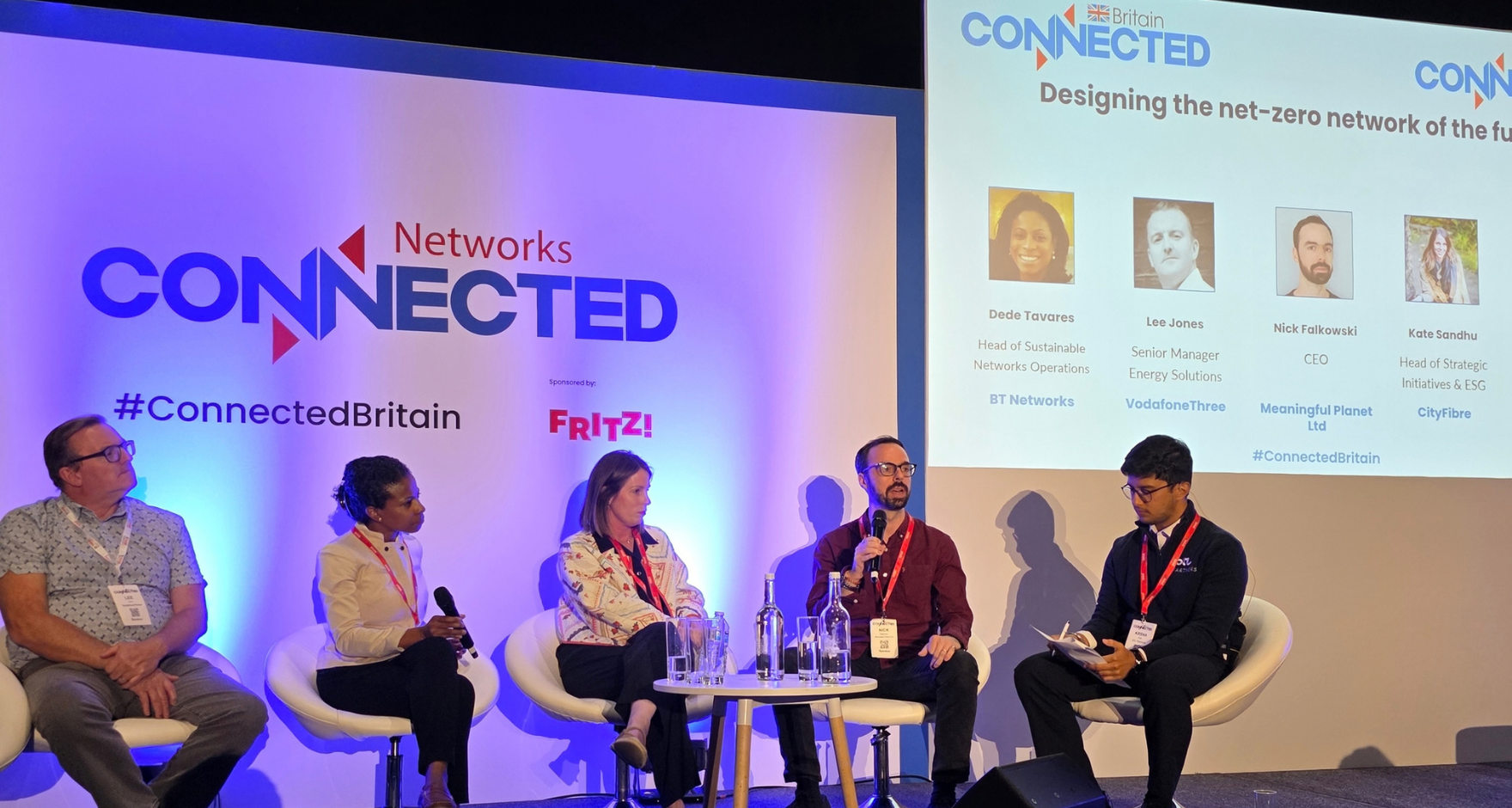
Meaningful Planet CEO and co-founder Nick Falkowski was there for the second year running, speaking on the panel for Designing the net-zero network of the future alongside Dede Tavares, Head of Sustainable Networks Operations at BT Networks; Lee Jones, Senior Manager Energy Solutions at VodafoneThree; and Kate Sandhu, Head of Strategic Initiatives & ESG at CityFibre.
The discussion was moderated by Krsna Singh, Research Analyst at STL Partners. STL’s own Telecoms Sustainability Scorecard now benchmarks 47 operators across areas including emissions, green finance, biodiversity and collaboration, so there was plenty of wider industry context behind the discussion.
AI, energy and network efficiency
The first part of the panel looked at a tension the industry is going to have to manage for some time: connectivity and compute demand are growing, particularly as AI adoption accelerates, while operators are also under pressure to reduce energy use and emissions.
That means continuing the more familiar work around renewable electricity, cooling, fleets, generators and network efficiency, while also looking at how technology can make networks themselves more intelligent. AI can increase demand, but it can also support things such as predictive traffic management, self-organising networks and smarter energy use.
For Meaningful Planet, the other side of that question is what enterprise customers are actually asking for. As businesses expand their use of AI, cloud and other data-intensive services, more of them want to understand the environmental impact of the infrastructure underneath those services, including connectivity.
Scope 3, supply chains and circularity
The harder part of telecoms emissions sits in Scope 3. STL Partners has estimated that this can account for more than 80% of a telecom service provider’s emissions, much of it sitting in equipment, construction, logistics and the wider supply chain.
That brings procurement into the centre of the sustainability discussion. The panel covered the role of supplier collaboration, the difficulty of creating consistent standards across operators and the importance of better carbon data moving through the value chain.
Circularity matters here too, not only because extending equipment life and recovering materials can reduce embodied emissions, but because telecoms businesses are exposed to global supply chains for critical minerals and specialist components. Reuse, recovery and better design can therefore support resilience as well as environmental goals.
That is particularly relevant to Meaningful Planet because we buy network capacity rather than build national infrastructure ourselves. The sustainability performance of our partners forms part of our own supply chain, and the quality of the data passed down that chain affects how confidently customers can understand the services they are buying.
Sustainability has to work commercially
The final part of the discussion moved into investment, standards and finance.
One of the themes from the panel preparation was the closer involvement of CFOs in sustainability decisions. That matters because environmental ambition increasingly has to stand up alongside the same commercial tests as any other investment.
In many cases, the strongest projects are the ones where the two reinforce each other. Lower energy use can reduce operating costs. Longer equipment life can reduce replacement requirements and supply-chain exposure. Better data can make procurement easier for customers.
There is a similar logic in the UK Government’s decision in July 2025 not to proceed with a UK Green Taxonomy. The Treasury concluded there was not compelling evidence that a taxonomy would materially change investment decisions, because classification alone does not change the underlying economics or risk of a project.
The bigger shift
The most useful thing about the conversation was how quickly “sustainable telecoms” stopped being a separate ESG topic and became a discussion about how networks are actually designed, bought and operated. Energy efficiency, procurement, equipment life, supplier data, resilience and investment decisions all sit inside the same system. That is probably where the subject becomes most useful: when sustainability is not treated as an extra layer around infrastructure, but as one of the inputs that shapes better infrastructure in the first place.