
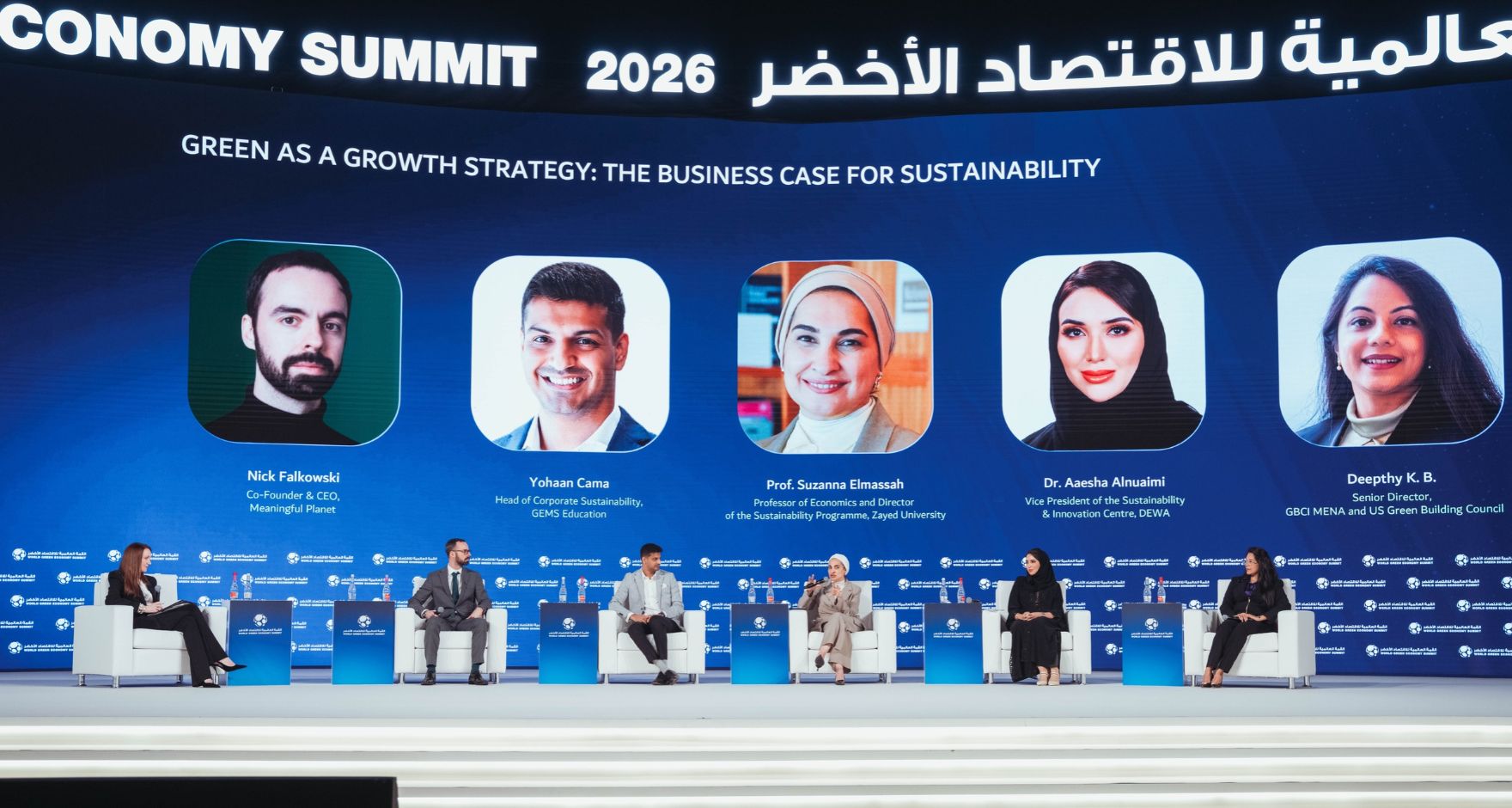
At the 12th World Green Economy Summit in Dubai on 21 October 2026, Meaningful Planet CEO and co-founder Nick Falkowski argued that businesses prioritising short-term gains risk being overtaken by those already investing in the future. Speaking on the panel “Green as a Growth Strategy: The Business Case for Sustainability” alongside speakers from DEWA, Zayed University, the U.S. Green Building Council, and GEMS Education, he made the case that sustainability will increasingly determine commercial success.
The summit
The World Green Economy Summit returned to Dubai World Trade Centre on 21–22 October 2026 for its 12th edition, under the theme “From Success to Scale: Showcasing the Green Economy”. Organised by the Dubai Supreme Council of Energy, Dubai Electricity & Water Authority (DEWA), and the World Green Economy Organisation (WGEO), the programme brought ministers, investors, and business leaders together around four pillars: energy technology and infrastructure, business strategy and transition, water and food security, and finance.
Meaningful Planet CEO and co-founder Nick Falkowski spoke on 21 October on the panel Green as a Growth Strategy: The Business Case for Sustainability, alongside Dr. Aaesha Alnuaimi of Dubai Electricity & Water Authority (DEWA), Prof. Suzanna ElMassah of Zayed University, Deepthy K B of GBCI MENA / U.S. Green Building Council, and Yohaan Cama of GEMS Education, in front of an audience that included investors and media.
A question about payback
Rebecca McLaughlin-Eastham, who moderated the session, put a question to the panel that sits at the heart of almost every sustainability strategy: “How do you justify making sustainability central to business strategy when the returns might take years?” It is a fair challenge, and one on which many strategies stall, because annual budgets and short reporting cycles tend to reward whatever pays back soonest.
Nick Falkowski, who found the question particularly pertinent right now, framed it in terms of where the economy is heading: “The future economy will be a green economy. The question is how quickly can we get there?” For him, the greater risk lies in waiting: “Businesses that prioritise short-term gains at the expense of long-term thinking risk being overtaken by those already investing in the future.” Sustainability, in his view, “isn’t at odds with commercial success: increasingly, it will be what determines it.”
That argument is easy to agree with in a conference hall and harder to test in practice, which is why it is most useful when applied somewhere a buyer can check it for themselves.
Buildings, utilities, education, and operations
The rest of the panel showed how the same question plays out in very different sectors. Deepthy K B brought the built-environment perspective, including LEED (Leadership in Energy and Environmental Design), the U.S. Green Building Council’s rating system for certifying sustainable buildings. Its latest version LEED v5 launched in 2025 and scores buildings on areas such as carbon, health, and resilience, with decarbonisation now worth half of all available points. Her focus also went beyond design to the harder problem of how existing buildings perform once they are in use.
Dr. Aaesha Alnuaimi described how a utility embeds sustainability into its core business and invests in the young people who will lead the transition, while Prof. Suzanna ElMassah made the case for sustainability as a driver of growth and competitiveness, and for educating today’s executives as well as tomorrow’s.
Yohaan Cama focused on operations and finance, showing how transparent operational data, from indoor air quality to running costs, prompts executives to ask questions and act, and how sustainability-linked finance can strengthen the case. Across all five speakers, the common thread was a move away from treating sustainability as a compliance exercise and towards treating it as part of how an organisation competes.
What long-term thinking looks like in business mobile
Business mobile is a useful test of that argument because here the long-term choice is not years away: it shows up in this year’s contract terms, this year’s bills, and, increasingly, this year’s reporting.
The most visible example is price rises, where the rules are still moving. Ofcom banned inflation-linked mid-contract rises in new contracts from January 2025 but still allows rises set out in pounds and pence. When O2 added a further 70p a month to its April 2026 increase, Ofcom said the move went against the spirit of its rules, and Money Saving Expert research published in June 2026 found that most customers were paying more under the new approach than under the old one.
A rise agreed at signing is revenue the provider collects whether or not the service has improved, which is why Meaningful Planet does not apply automatic mid-contract price rises. Our guide to mid-contract price rises explains how they work and what businesses can do about them.
The second test is what happens when a business keeps paying for unused SIMs across the company. Leavers’ SIMs, dormant lines, and plans sized for usage that never materialised are a familiar reason mobile costs climb, and in a model built on short-term revenue nobody has much reason to point them out.
The practical fix starts with seeing every SIM’s usage in one place: SOVA, our management platform, flags unused or dormant SIMs, unusual usage, and plans that are consistently overprovisioned, then recommends actions for a person to approve, such as suspending or removing a connection or moving to a lower-cost plan where that is the better fit. Giving up that revenue is exactly the kind of trade-off the panel was asked about, and we think it is what earns a customer’s trust over the long term.
The third test is emissions data, and this is where the conversation has moved fastest this year. The GSMA’s Mobile Net Zero 2026 report found that around three quarters of the mobile industry’s carbon footprint sits in Scope 3, in supply chains rather than in operators’ own networks, and business customers now face the same problem from the other side.
Under the Financial Conduct Authority’s Policy Statement PS26/19, companies with shares in the commercial companies category and other in-scope listing categories will report against UK Sustainability Reporting Standards for accounting periods beginning on or after 1 January 2027, on a comply-or-explain basis that includes Scope 3 emissions, which means asking suppliers for figures that will stand up in a report.
As a business mobile provider, we calculate the emissions for each business SIM from its actual network usage and call-data records, using benchmark emissions factors, and customers can access that per-SIM emissions data for their own operational and Scope 3 reporting. We offset those emissions, together with our own operational footprint, as standard, and separately direct 10% of profits to UK nature restoration through regional Wildlife Trust partnerships.\
The bigger point
The most useful thing about the discussion in Dubai was how quickly “the business case for sustainability” stopped being an argument about long-term returns in general and became a set of practical choices about how organisations build, buy, and run things.
For a UK business choosing a mobile provider, those choices are unusually easy to check: whether the price can rise mid-contract, whether anyone will tell you what you are paying for and not using, and whether the emissions figures you receive will hold up in a report. Each of them costs the provider something in the short term, which is precisely what makes them a fair test of whether a business means what it says about the long term.